The hourglass timer: from ancient timekeeper to modern focus tool
The hourglass timer: from ancient timekeeper to modern focus tool
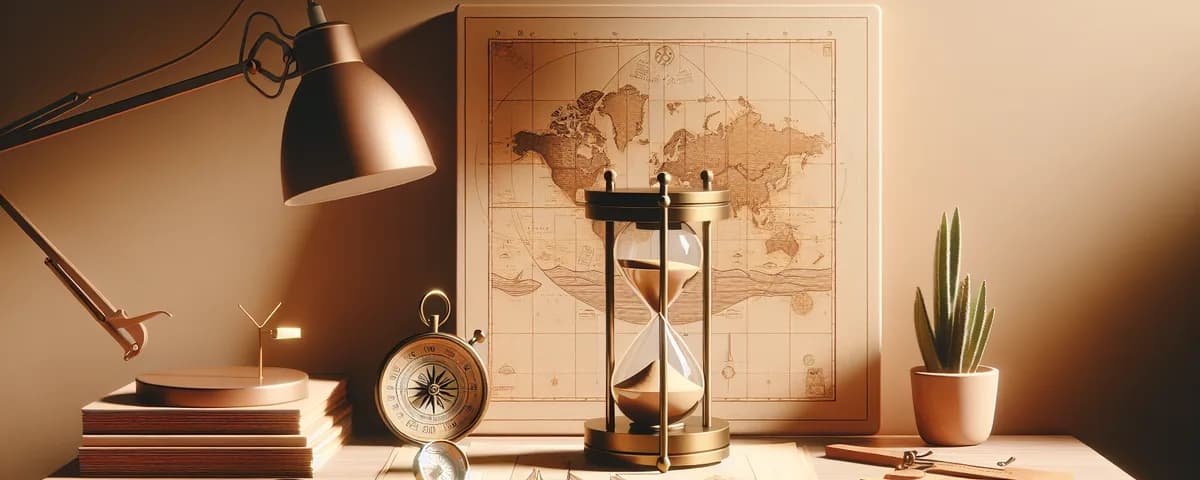
The hourglass is one of the most recognizable objects in human history. Two glass bulbs, a narrow neck, and a stream of falling sand. It has been measuring time for at least 700 years, and despite quartz clocks, atomic timers, and smartphone apps, the hourglass refuses to become obsolete. In fact, it is making a comeback as a productivity and focus tool, especially in digital form.
Here is the story of the hourglass and why its core principle, visible time flowing away, remains one of the most effective ways to stay on task.
The invention of the hourglass
The exact origin of the hourglass is debated, but the earliest reliable references appear in European sources from the early 14th century. A 1338 fresco by Ambrogio Lorenzetti in Siena, Italy, contains one of the first clear depictions of a sand hourglass. Some historians believe earlier versions existed in the 8th century aboard Arab trading ships, though hard evidence is thin.
What we know for certain: by the 1400s, hourglasses were standard equipment across Europe. They were relatively cheap to produce, reliable in any weather (unlike water clocks, which froze), and portable. A glassblower could produce the bulbs, a craftsman could build the frame, and finely ground marble or eggshell could serve as the flowing medium.
How hourglasses work
The physics are elegant. Sand flows through the narrow neck at a constant rate determined by three factors: the diameter of the neck, the size and shape of the grains, and the diameter of the bulbs. A wider neck means faster flow. Rounder, more uniform grains flow more smoothly than jagged ones. The bulb diameter affects pressure on the grains near the neck.
Early hourglasses used not sand but powdered marble, crusite (burnt and ground eggshell), or fine tin dust. True sand was too irregular. Modern decorative hourglasses typically use manufactured glass microspheres for consistency.
One underappreciated detail: hourglasses are not perfectly linear. The flow rate is nearly constant because the pressure at the neck depends primarily on the column of sand directly above it, not the total amount in the upper bulb. This is unlike water clocks, where flow rate decreases as the water level drops. This physical property made hourglasses remarkably accurate for their era.
Historical uses
Navigation. Before reliable marine chronometers, ships used hourglasses to measure speed and time during watches. Sailors flipped a 30-minute glass to track four-hour watch shifts. The phrase "the sands of time" entered language directly from this maritime practice.
Church sermons. Congregations placed hourglasses next to the pulpit, visible to both preacher and audience. When the sand ran out, the sermon was supposed to end. Some preachers simply flipped the glass and kept going, which reportedly did not improve attendance.
Cooking. Before kitchen timers existed, cooks used small hourglasses to time the boiling of eggs, the baking of bread, and the brewing of tea. Three-minute egg timers descended directly from this tradition and some are still sold today.
Law and governance. Courts used hourglasses to limit the length of arguments. Legislative bodies timed debates with them. The visible, impartial flow of sand made the hourglass a symbol of fairness.
The hourglass in modern culture
The hourglass transcended its practical function to become one of civilization's most enduring symbols. It represents mortality, urgency, and the passage of time in art, literature, and design. The loading cursor on older computers was an hourglass. Board games from Boggle to Pictionary still ship with sand timers. The hourglass figure in fashion, the Hourglass Nebula in space, the tattoo on a million forearms: the symbol is everywhere.
This cultural weight is not accidental. The hourglass communicates something that a digital number does not: time is a physical substance that you can watch drain away.
Why visual timers work for focus
This brings us to the science. Research in cognitive psychology shows that visual representations of time passing are more effective at maintaining focus than auditory or numerical cues. A 2019 study published in the Journal of Experimental Psychology found that participants working with a visible countdown completed tasks 23% faster and reported lower perceived effort than those using only an audible alarm.
The mechanism is straightforward. A visual timer provides continuous, ambient feedback. You do not need to check it actively; you can see it in your peripheral vision. This creates gentle time pressure without the anxiety spike of suddenly realizing you have 2 minutes left.
This is exactly why the hourglass concept has been revived in digital form. A digital hourglass timer recreates the sand-flow animation on screen, combining the psychological benefits of visible time depletion with the precision of digital timing. You get the focus benefit of watching sand fall without needing a physical glass on your desk.
Digital hourglass timers
A digital hourglass timer works like its glass ancestor but with added flexibility. You can set any duration rather than being locked to the physical glass's fixed time. You can adjust colors, sounds, and display styles. And you never have to worry about someone bumping your desk and knocking the thing over.
For quick focus bursts, a 5-minute hourglass timer replicates the short sand timer used in board games and classrooms. Set it running, focus on a single task until the sand runs out, then decide whether to flip it again.
Digital hourglasses also pair well with other visual timing approaches. A visual timer uses the same principle of showing time as a shrinking visual element, whether it is sand, a pie chart, or a color bar. The visual timer guide for ADHD and focus explains why this approach works especially well for attention challenges.
When to use an hourglass timer
The hourglass format works best in specific situations:
Focus sessions. When you need 15-30 minutes of uninterrupted work on a single task. The visual sand flow keeps you anchored without requiring you to check a clock. Start a session, glance at the hourglass occasionally, and return to your work.
Kids' tasks. Children respond exceptionally well to visual timers. Telling a six-year-old "you have 5 minutes to clean up" means nothing. Showing them sand flowing through a glass gives them a concrete, understandable representation of the time remaining. Teachers have used sand timers in classrooms for decades for exactly this reason.
Presentations and meetings. Place a visible hourglass timer on screen during a presentation to keep yourself on pace. It signals respect for the audience's time and prevents you from running over. Speakers who use visible timers consistently finish within 10% of their target duration.
Cooking and short tasks. For any task where you need a rough time boundary, an hourglass is simpler than setting a precise digital alarm. Steeping tea, stretching, waiting for glue to set: flip the glass and get on with something else.
The visual timer advantage for ADHD
People with ADHD often experience "time blindness," a difficulty in perceiving how much time has passed or how much remains. This is not a matter of motivation or discipline; it is a neurological difference in how the brain processes temporal information.
Visual timers directly address time blindness by externalizing time as a visible, physical process. Research from the University of Central Florida found that children with ADHD who used visual timers during homework completed 30% more problems and had fewer off-task intervals compared to those using standard clocks.
The hourglass is arguably the purest form of visual timer. There is no number to interpret, no abstraction to process. Sand falls. When it stops, time is up. This simplicity is the hourglass's greatest strength, and it is why a tool invented 700 years ago remains relevant in an age of smartwatches and AI assistants.
For a deeper look at different timer formats and which ones suit various tasks, the complete guide to types of timers covers everything from hourglasses to Pomodoro timers to interval timers and when each one works best.
A tool that outlasted empires
The hourglass has survived the pendulum clock, the pocket watch, the digital alarm, and the smartphone timer. It survives because it solves a fundamental human problem: making invisible time visible. Whether you use a hand-blown glass with real sand or a digital hourglass on your screen, the principle is the same. Watch the sand fall. Do the work. Flip it again.
Try it free
Hourglass Timer
Builds tools that get used. Founded Timerjoy after a frustrated search for an ad-free online timer. More about the project.