Moon phases explained: a complete guide to the lunar cycle
What causes moon phases?
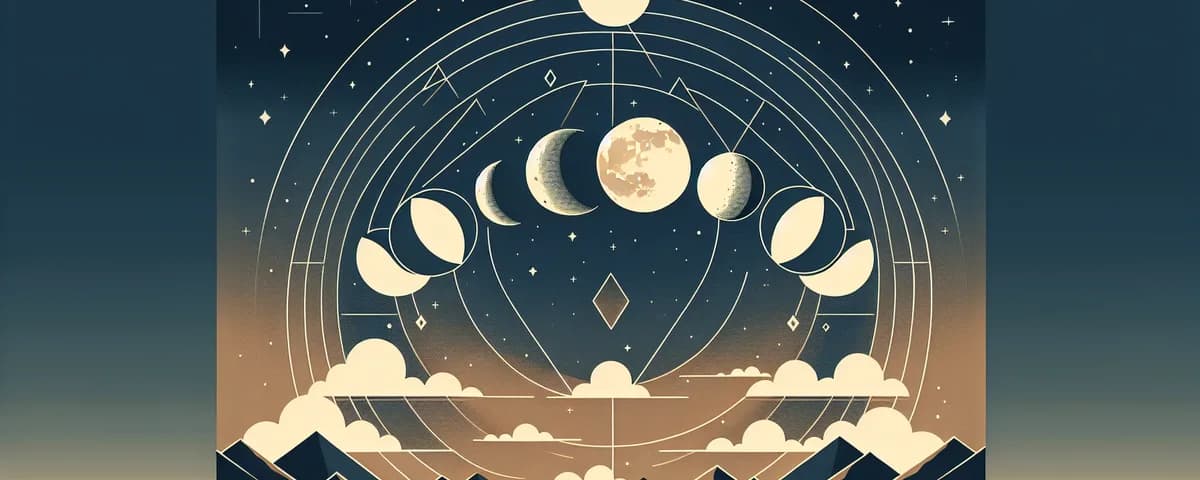
The Moon doesn't produce its own light — it reflects sunlight. As the Moon orbits the Earth (a journey that takes about 29.5 days), we see different portions of its sunlit surface from our vantage point. These changing angles create the eight distinct phases we call the lunar cycle.
A common misconception is that Earth's shadow causes moon phases. That's actually a lunar eclipse, which is a much rarer event. Moon phases are simply about geometry — the relative positions of the Sun, Earth, and Moon as the Moon travels along its orbit.
You can track the current lunar cycle with our moon phase calendar, which shows daily illumination percentages and exact dates for every major phase.
The eight phases of the lunar cycle
New Moon — The Moon is positioned between the Earth and Sun, with its sunlit side facing away from us. The Moon is invisible in the night sky. This is the start of the lunar cycle.
Waxing Crescent — A thin sliver of light appears on the right side of the Moon (in the Northern Hemisphere). "Waxing" means growing. The illumination increases from about 1% to 49%.
First Quarter — Exactly half the Moon's face is illuminated — the right half. Despite the name "quarter," half the Moon appears lit. The name refers to the Moon being one-quarter through its orbit.
Waxing Gibbous — More than half the Moon is illuminated, growing toward full. "Gibbous" comes from the Latin word for "hump," describing the shape of the lit area (50%–99%).
Full Moon — The entire face of the Moon is illuminated. The Earth is positioned between the Sun and Moon. This is when the Moon rises at sunset and sets at sunrise, making it visible all night.
Waning Gibbous — The illumination begins to decrease from the left side. "Waning" means shrinking. The lit area decreases from 99% back toward 50%.
Last Quarter (Third Quarter) — The left half of the Moon is illuminated. The Moon is now three-quarters through its cycle.
Waning Crescent — A thin sliver remains on the left side, shrinking toward the next New Moon. Sometimes called the "old Moon."
Check the exact dates for each phase in any month with our lunar calendar.
Why full moon dates matter
Full moons have practical significance beyond their beauty. Many activities are directly affected by lunar phases:
Fishing — Many anglers plan trips around the full and new moons, when tidal movements are strongest (spring tides). Fish tend to feed more actively during these periods. The days just before and after a full moon are considered prime fishing times.
Gardening — Biodynamic gardening follows a lunar planting calendar. Root crops are planted during the waning moon, while above-ground crops are planted during the waxing moon. While scientific evidence is mixed, the tradition dates back thousands of years.
Photography — Landscape photographers plan shoots around moon phases. A full moon near the horizon during golden hour creates dramatic compositions. Astrophotographers prefer new moon periods when the sky is darkest.
Astronomy — Stargazing is best during new moon periods when moonlight doesn't wash out faint objects. Check our sunrise and sunset times alongside moon phases for optimal viewing conditions.
Tides — Full and new moons produce the highest tides (spring tides) because the gravitational pulls of the Sun and Moon align. Quarter moons produce the lowest tidal range (neap tides).
Full moon names by month
Traditional full moon names come from Native American, Colonial American, and European traditions. Each month's full moon has a distinctive name:
- January — Wolf Moon (wolves howled in hunger during midwinter)
- February — Snow Moon (heaviest snowfall typically occurs)
- March — Worm Moon (earthworms emerge as the ground thaws)
- April — Pink Moon (named for wild phlox, one of spring's first flowers)
- May — Flower Moon (abundant wildflowers bloom)
- June — Strawberry Moon (strawberry harvesting season)
- July — Buck Moon (male deer begin growing new antlers)
- August — Sturgeon Moon (Great Lakes sturgeon were most easily caught)
- September — Harvest Moon (closest full moon to the autumnal equinox)
- October — Hunter's Moon (the preferred month for hunting)
- November — Beaver Moon (time to set beaver traps before winter)
- December — Cold Moon (winter cold tightens its grip)
Find exact dates for every full moon in our 2026 lunar calendar.
Supermoons, blue moons, and lunar eclipses
A supermoon occurs when the full moon coincides with the Moon's closest approach to Earth (perigee). The Moon's orbit is elliptical, so its distance from Earth varies between about 226,000 and 252,000 miles. A supermoon appears roughly 7% larger and 15% brighter than an average full moon.
A blue moon has two definitions. The traditional definition is the third full moon in a season that contains four full moons. The popular definition — the second full moon in a single calendar month — is actually based on a 1946 misinterpretation in Sky & Telescope magazine that became widely adopted.
A lunar eclipse occurs when the Earth passes directly between the Sun and Moon, casting its shadow on the lunar surface. During a total lunar eclipse, the Moon often appears deep red (a "blood moon") because Earth's atmosphere bends red wavelengths of sunlight onto the Moon's surface. Unlike moon phases, eclipses are relatively rare — only 2 to 5 occur per year.
The Moon's effect on Earth
The Moon's gravitational pull creates ocean tides, stabilizes Earth's axial tilt (which keeps our seasons relatively consistent), and gradually slows Earth's rotation — days are getting about 2.3 milliseconds longer per century.
Without the Moon, Earth's axis would wobble chaotically, potentially swinging from 0° to 85° over millions of years. This would make seasons extreme and unpredictable, possibly preventing complex life from developing. In a very real sense, we owe our stable climate to the Moon.
The Moon is also slowly moving away from Earth — about 1.5 inches per year. Billions of years from now, it will appear too small to create total solar eclipses.
How to observe moon phases
You don't need a telescope to enjoy moon phases. Here are practical observation tips:
Best times to observe: The most dramatic viewing is during crescent and quarter phases, when sunlight hits the Moon at an angle and creates long shadows along the terminator (the line between light and dark). Craters and mountains are most visible along this line. Full moons, while spectacular, appear flat because the light hits straight on with no shadows.
When the moon rises and sets: The Moon rises roughly 50 minutes later each day. A full moon rises near sunset and sets near sunrise. A new moon rises and sets with the Sun. First quarter moons are visible in the afternoon and evening sky.
Binoculars vs. telescope: A simple pair of 10x50 binoculars reveals stunning crater detail. You don't need expensive equipment. Steady your binoculars against a wall or use a tripod adapter for the sharpest views.
Frequently asked questions
How long is a lunar cycle?
The synodic period (new moon to new moon) is approximately 29.53 days. This is different from the sidereal period (27.32 days), which measures the Moon's orbit relative to the stars rather than the Sun.
Can you see the Moon during the day?
Yes. The Moon is above the horizon for roughly 12 hours per day regardless of phase. During first quarter, it's visible in the afternoon. During last quarter, it's visible in the morning. Only near the new moon is it difficult to see because it's so close to the Sun.
Why does the full moon look bigger on the horizon?
This is the "Moon illusion" — a psychological phenomenon where the Moon appears larger near the horizon than when it's high in the sky. The Moon's actual angular size doesn't change significantly. Scientists believe our brains compare the Moon to foreground objects (trees, buildings) near the horizon, making it seem larger by comparison.
Does the full moon affect human behavior?
Despite popular belief, large-scale studies have found no significant correlation between full moons and emergency room visits, crime rates, or mental health crises. The word "lunatic" comes from the Latin luna (moon), reflecting an ancient belief that the Moon caused madness — but modern research doesn't support this.
What is the dark side of the Moon?
There is no permanently dark side. The Moon rotates on its axis at the same rate it orbits Earth (tidal locking), so the same face always points toward us. The far side receives just as much sunlight as the near side — we simply never see it from Earth. "Far side" is the more accurate term.
Try it free
Moon Phases
Builds tools that get used. Founded Timerjoy after a frustrated search for an ad-free online timer. More about the project.